
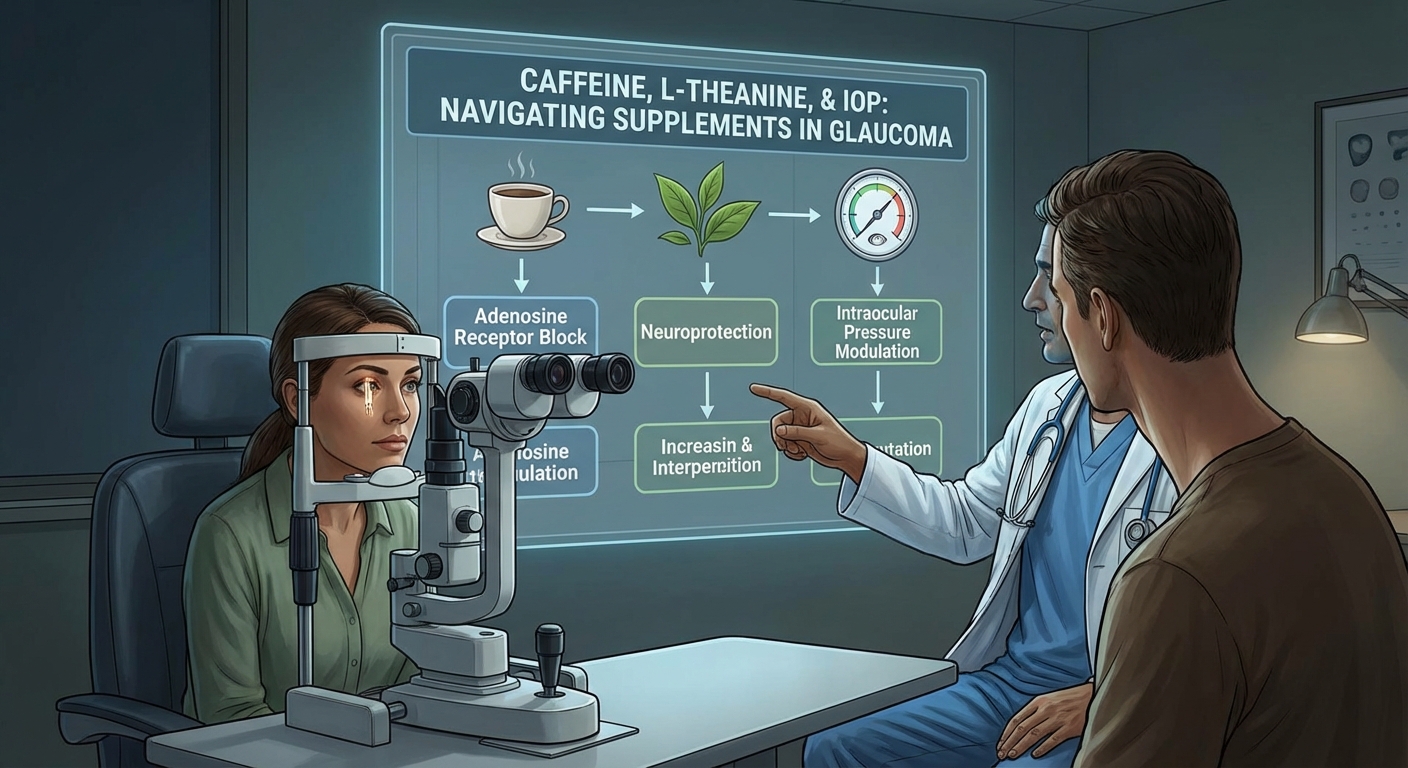
Caffeine, L-Theanine, and IOP in Glaucoma
Glaucoma patients often wonder whether common stimulants or supplements might affect their eye pressure (intraocular pressure, IOP). Caffeine – a central nervous system stimulant found in coffee, tea and energy drinks – can transiently raise blood pressure and may influence IOP. By contrast, L-theanine (an amino acid abundant in green tea) is known for calming stress and modestly lowering blood pressure. This article reviews the evidence on how acute and habitual caffeine intake affect IOP and ocular perfusion pressure, whether L-theanine might modulate stress-related vascular tone relevant to glaucoma, and how dose, timing and individual factors play a role. We also discuss practical risk–benefit advice for glaucoma patients considering these supplements.
Caffeine and Intraocular Pressure
Acute IOP Response
Controlled trials show that drinking caffeinated beverages causes a small, short-lived rise in IOP for most people. For example, a randomized trial of glaucoma patients found that ingesting a cup of coffee (about 180 mg caffeine) raised IOP by ~1 mmHg on average at 60–90 minutes post-drink (pmc.ncbi.nlm.nih.gov) (pmc.ncbi.nlm.nih.gov). This increase was statistically significant but described as “not clinically significant” in that study (pmc.ncbi.nlm.nih.gov). In healthy individuals, caffeine from coffee or tea typically causes no measurable IOP change (pubmed.ncbi.nlm.nih.gov). However, in people with glaucoma or ocular hypertension, a meta-analysis of several trials reported average IOP elevations of ~2–3 mmHg within 1–1.5 hours after caffeine (pubmed.ncbi.nlm.nih.gov). In other words, an acute caffeine spike seems to have a larger effect on eye pressure in glaucoma patients, though the overall rise is modest.
Many factors could explain this variability. Pure caffeine itself (separated from other coffee components) does not raise IOP – one small study applied 1% caffeine eye drops to glaucoma patients and saw no significant pressure change (pmc.ncbi.nlm.nih.gov). This suggests that other compounds in coffee or the blood-pressure–raising effect of caffeine might drive the IOP increase seen with drinking coffee. Indeed, when blood pressure rises (as it does with caffeine), the ocular perfusion pressure (OPP, a measure of blood flow driving pressure) also rises. In the Jiwani trial, caffeinated coffee increased OPP by ~1.3–1.6 mmHg at 60–90 minutes (pmc.ncbi.nlm.nih.gov). Higher OPP generally improves eye blood flow, but since IOP also rose slightly, the net effect on ocular blood supply is unclear. Nevertheless, the primary concern is the pressure change itself: caffeine’s stimulatory effect (via adenosine blockade and other mechanisms) appears to cause a brief rise in aqueous production or vascular tone that transiently hikes IOP in susceptible eyes (pmc.ncbi.nlm.nih.gov).
Importantly, caffeine’s effects are short-lived. Blood levels peak about 30–120 minutes after ingestion and dissipate over 3–6 hours (pmc.ncbi.nlm.nih.gov). In fact, one study found that by 4 hours after coffee, IOP had returned to baseline (pmc.ncbi.nlm.nih.gov). Thus, caffeine-induced IOP elevations occur within the first couple of hours of drinking and typically fade by morning if coffee is consumed at breakfast. For a glaucoma patient, this means timing matters: a late-afternoon espresso might keep IOP slightly higher into the evening, whereas earlier morning coffee will be out of the system by bedtime.
Chronic Intake and Tolerance
Habitual caffeine consumption can attenuate the acute IOP response. People who regularly drink coffee often develop some tolerance to its effects. In a crossover study, low-caffeine drinkers (occasional coffee consumers) showed a sharp IOP rise (+3.4 mmHg at 90 minutes after 200–300 mg caffeine) compared to habitual high-caffeine drinkers (+1.2 mmHg) (pubmed.ncbi.nlm.nih.gov). Likewise, epidemiological data suggest that long-term coffee habits only weakly influence IOP on average. For instance, the Blue Mountains Eye Study observed that among healthy subjects there was no link between usual coffee intake and IOP, and even among glaucoma patients the difference in IOP (for ≥200 mg/day vs <200 mg/day caffeine consumers) was a non-significant ~2 mmHg (pmc.ncbi.nlm.nih.gov). Put simply, a regular coffee drinker may experience a smaller pressure bump from a cup of joe than someone who rarely consumes caffeine [Source 4] (pmc.ncbi.nlm.nih.gov).
Genetic Factors and Habitual Intake
Large population studies echo these findings. A UK Biobank analysis of >120,000 adults found that habitual high caffeine intake was associated with only a very slight lower IOP in the general sample (pmc.ncbi.nlm.nih.gov). Overall glaucoma risk was unrelated to coffee or tea drinking levels (pmc.ncbi.nlm.nih.gov). However, the same study found that people with a strong genetic predisposition to high eye pressure (a high polygenic risk score) did show a small increase in IOP (≈0.35 mmHg) and glaucoma prevalence if they consumed large amounts of caffeine (>320–480 mg/day) (pmc.ncbi.nlm.nih.gov) (pmc.ncbi.nlm.nih.gov). In other words, genetics may tip the balance: most patients experience little long-term harm from moderate caffeine, but those already prone to glaucoma might see extra risk if they drink very large amounts.
L-Theanine: Anti-Stress Effects and Vascular Tone
L-theanine is an amino acid found in green tea (Camellia sinensis) that has calming, anti-anxiety effects. It can cross the blood–brain barrier and modulate neurotransmitters, often promoting alpha waves that correspond to relaxed alertness. Importantly, L-theanine appears to blunt stress responses. In controlled trials, 200 mg L-theanine significantly inhibited stress-induced blood pressure spikes during mental tasks, especially in individuals whose blood pressure would otherwise rise sharply (pmc.ncbi.nlm.nih.gov). In the same experiments, caffeine alone also tended to reduce stress BP rises, but less so than L-theanine (pmc.ncbi.nlm.nih.gov). Surveys and animal studies support that L-theanine moderates the release of stress hormones and improves measures of anxiety (pmc.ncbi.nlm.nih.gov).
By reducing stress-related increases in systemic blood pressure, L-theanine could indirectly benefit glaucoma. High stress and hypertension can constrict ocular blood vessels and potentially affect IOP. If L-theanine keeps blood pressure steadier and lowers anxiety levels (“Tension-Anxiety” scores were reduced in L-theanine trials (pmc.ncbi.nlm.nih.gov)), it might help maintain stable ocular perfusion without causing harmful spikes. However, no direct studies have measured L-theanine’s effect on IOP or eye blood flow. Its main promise is as an adjunct: for a person drinking green tea or taking L-theanine supplements, the relaxation effect might counterbalance any mild stimulant impact of residual caffeine, yielding a gentler net influence on the vascular system.
Dose, Timing, and Individual Responsiveness
Patients should consider dose thresholds and timing. Typical caffeinated beverages contain varying caffeine amounts: roughly 80–100 mg per 8-oz cup of brewed coffee, 40–50 mg per cup of black tea, and about 30–40 mg for a soda (pubmed.ncbi.nlm.nih.gov) (www.fda.gov). Energy drinks and specialty coffees can exceed 200–300 mg per serving. Health authorities generally deem up to 400 mg/day (~4 cups of coffee) as safe for most adults (www.fda.gov). Below this level, for most glaucoma patients the evidence suggests only small IOP changes. However, drinking very high doses (e.g. >400–500 mg/day) might push some individuals into concerning BP and pressure elevations, especially if consumed rapidly.
Timing matters because caffeine’s effects peak within ~1–2 hours. An early morning cup will mainly affect mid-morning IOP, whereas late afternoon or evening caffeine can keep IOP elevated when naturally it is higher (IOP follows a circadian rhythm). Glaucoma medications also have timing schedules (some applied at night, others in the morning). There is no strong evidence that caffeine interferes pharmacologically with glaucoma drops or lasers, but it can offset some pressure-lowering by briefly raising IOP. Patients may therefore choose to avoid caffeine within a couple of hours of their ocular measurements or doctor visits.
Individual variability is considerable. As noted, habitual consumers and younger individuals (with more efficient caffeine metabolism) usually see less pressure change than caffeine-sensitive or low-tolerance people (pubmed.ncbi.nlm.nih.gov) (pmc.ncbi.nlm.nih.gov). Genetic factors, body weight and coexisting blood pressure issues also play roles. For example, smal gene–diet studies suggest those with a family tendency to high IOP should be more cautious with large caffeine loads (pmc.ncbi.nlm.nih.gov). In contrast, L-theanine has shown relatively consistent calming effects across subjects, though the magnitude of anxiety reduction varies.
Clinical and Risk–Benefit Considerations
From a risk–benefit standpoint, moderate caffeine (1–2 cups of coffee daily) is likely safe for most glaucoma patients, particularly if their IOP is well-controlled on medication. The transient rise of 1–2 mmHg after a cup is usually within the normal fluctuation range (pmc.ncbi.nlm.nih.gov) (pmc.ncbi.nlm.nih.gov). On the plus side, caffeine can improve alertness, mood and concentration, which may benefit quality of life. Some animal and cell studies even hint at neuroprotective antioxidant effects of coffee compounds (independent of IOP) (pmc.ncbi.nlm.nih.gov), though that is speculative for glaucoma.
However, heavy or binge consumption can be counterproductive. If a patient finds their IOP trending high or notices vision changes around intensive caffeine use, it would be prudent to cut back. Glaucoma specialists often recommend monitoring IOP after coffee to see if an individual is sensitive. By contrast, L-theanine supplementation (for stress reduction) likely poses little risk. At common doses (100–200 mg), its main effects are anxiety-reduction and modest blood-pressure lowering (pmc.ncbi.nlm.nih.gov) (pmc.ncbi.nlm.nih.gov). There are no reports of L-theanine worsening IOP; on the contrary, its ability to dampen stress may indirectly help stabilize ocular blood flow. If a patient is taking antihypertensive or IOP-lowering drugs, adding L-theanine is generally safe, but any supplement should be discussed with a doctor to avoid unexpected interactions.
In summary, caffeine tends to cause brief IOP elevations of about 1–3 mmHg, peaking around 1 hour after intake and wearing off by a few hours (pmc.ncbi.nlm.nih.gov) (pmc.ncbi.nlm.nih.gov). The effect is milder in habitual consumers (pmc.ncbi.nlm.nih.gov). L-theanine has an opposite profile: it helps attenuate stress-induced blood pressure and anxiety without known harm to the eye (pmc.ncbi.nlm.nih.gov). Glaucoma patients on medication should weigh the alertness benefit of caffeine against its small pressure-stimulating effect. For those with poorly controlled IOP or a strong family history, a lower caffeine intake or substituting green tea (with its theanine content) could be sensible. Always consult an ophthalmologist before making major diet changes.
Conclusion
Caffeine and L-theanine, common components of coffee and tea, do have modest impacts on ocular physiology. Caffeine can raise intraocular pressure and systemic blood pressure transiently (by ~1–2 mmHg at typical doses) (pmc.ncbi.nlm.nih.gov) (pmc.ncbi.nlm.nih.gov), whereas L-theanine tends to reduce stress-related blood pressure spikes (pmc.ncbi.nlm.nih.gov). Crucially, the overall evidence suggests moderate caffeine intake is not a major glaucoma risk factor (pmc.ncbi.nlm.nih.gov), provided patients remain aware of their individual response. Glaucoma sufferers should consider their overall caffeine dose, timing with respect to eye drops or tests, and genetic or health risk profile. Using L-theanine can be beneficial for stress relief, with little downside. In all cases, patients should discuss supplement use with their care team, balancing lifestyle habits with strict IOP control to protect their vision.