
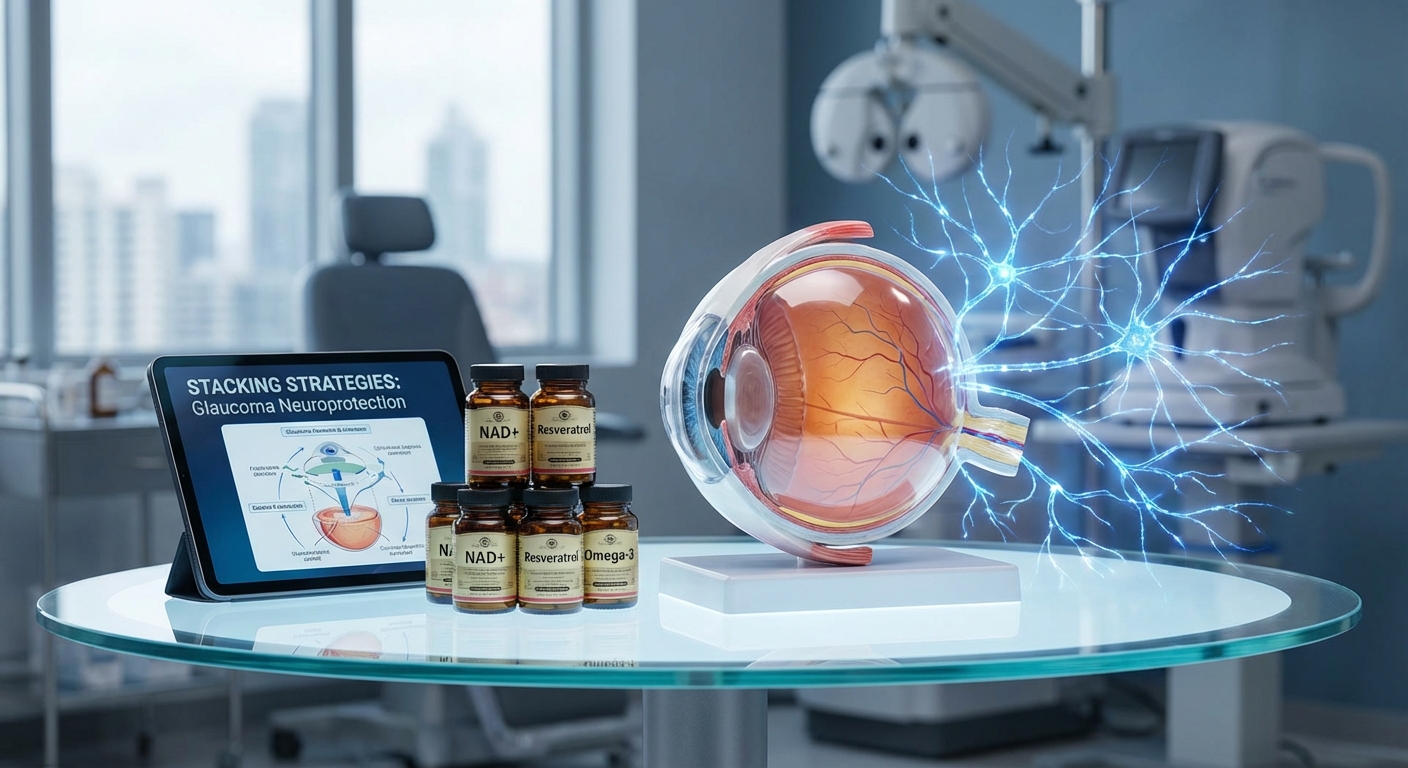
Stacking Strategies for Glaucoma Neuroprotection
Glaucoma is a progressive optic neuropathy characterized by retinal ganglion cell (RGC) apoptosis that leads to irreversible vision loss. Beyond elevated intraocular pressure (IOP), factors such as oxidative stress, mitochondrial dysfunction, excitotoxicity, and neuroinflammation drive glaucomatous damage (pmc.ncbi.nlm.nih.gov). While lowering IOP remains the cornerstone of therapy, many patients continue to lose vision despite optimal pressure control (pmc.ncbi.nlm.nih.gov). This gap has spurred interest in neuroprotective supplements – many of which are also promoted as “longevity” agents – to complement standard treatments. Because glaucoma involves multiple pathogenic pathways, combining supplements with complementary mechanisms (“stacking”) may yield additive or synergistic protection of RGCs (pmc.ncbi.nlm.nih.gov). In this article we examine promising supplement pairings, review preclinical and clinical evidence for synergy, address safety concerns of multi-supplement regimens, and suggest how factorial clinical trials with composite endpoints could test these multi‐agent strategies.
Rationale for Combination Neuroprotection
Given glaucoma’s multifactorial pathobiology, a multi-targeted approach is appealing. Supplement combinations can target metabolic support, antioxidation, vascular support, and excitotoxicity simultaneously. For example, nicotinamide (vitamin B3) boosts NAD⁺ levels to improve mitochondrial resilience, while pyruvate fuels energy metabolism and scavenges reactive oxygen species (pmc.ncbi.nlm.nih.gov) (pmc.ncbi.nlm.nih.gov). Coenzyme Q10 (CoQ10) preserves mitochondrial bioenergetics and inhibits glutamate excitotoxicity, whereas vitamin E protects cell membranes from lipid peroxidation (pmc.ncbi.nlm.nih.gov) (pmc.ncbi.nlm.nih.gov). Ginkgo biloba extract provides flavonoid antioxidants and enhances optic nerve blood flow (pmc.ncbi.nlm.nih.gov), while magnesium can increase ocular perfusion and block NMDA-mediated calcium influx (pmc.ncbi.nlm.nih.gov). Pairing such agents aims to cover weak spots of monotherapy: for instance, combining a vasodilator/antioxidant (Ginkgo) with an NMDA antagonist (Mg) addresses both vascular dysregulation and excitotoxicity.
Several reviews have pointed out that synergy has been observed in models when agents are combined across pathways (pmc.ncbi.nlm.nih.gov). In experimental glaucoma models, nicotinamide and pyruvate together were found to be more protective than either alone (pmc.ncbi.nlm.nih.gov). Clinically, fixed-dose combinations like citicoline + CoQ10 ± vitamin B3 or nicotinamide + pyruvate have shown additive gains in retinal electrophysiology and visual function over individual agents (pmc.ncbi.nlm.nih.gov). These findings motivate stacking strategies in glaucoma: judiciously pairing longevity supplements to amplify benefits while covering distinct mechanisms.
Complementary Supplement Pairings
Nicotinamide (Vitamin B₃) + Pyruvate
Mechanisms: Nicotinamide is a NAD⁺ precursor that bolsters mitochondrial function and cellular energy metabolism. Glaucomatous stress depletes retinal NAD⁺, rendering RGCs vulnerable; nicotinamide supplementation restores NAD⁺ and protected mice from optic nerve degeneration (pmc.ncbi.nlm.nih.gov). Pyruvate, a key glycolytic metabolite, supports ATP production, has antioxidant properties, and reverses ischemic metabolic defects. In animal glaucoma models, pyruvate preserved RGCs and optic nerve fibers (pmc.ncbi.nlm.nih.gov). Notably, Harder et al. reported that combining nicotinamide and pyruvate was the most protective regimen in a chronic mouse model of glaucoma (pmc.ncbi.nlm.nih.gov).
Evidence: The only reported human trial of this combination is a Phase 2 randomized study by De Moraes et al (pmc.ncbi.nlm.nih.gov). In 32 treated glaucoma patients, escalating oral doses of nicotinamide (1–3 g) plus pyruvate (1.5–3 g) over ~2 months significantly increased the number of visual field locations showing improvement, compared to placebo (pmc.ncbi.nlm.nih.gov). No serious adverse events occurred, and the treatment group had better pattern standard deviation slopes (reflecting field stability) than controls (pmc.ncbi.nlm.nih.gov). The authors concluded that nicotinamide + pyruvate was safe and yielded short-term visual benefits, supporting its role in glaucoma neuroprotection (pmc.ncbi.nlm.nih.gov). Indeed, a review notes additive electrophysiologic and functional gains in trials using nicotinamide+pyruvate combos (pmc.ncbi.nlm.nih.gov). While longer trials are needed to confirm sustained structural benefits, the human data so far align with preclinical synergy (pmc.ncbi.nlm.nih.gov) (pmc.ncbi.nlm.nih.gov).
Coenzyme Q10 + Vitamin E
Mechanisms: CoQ10 (ubiquinone) is a mitochondrial electron carrier and antioxidant. It helps maintain ATP production and scavenges free radicals in retinal neurons. Vitamin E (tocopherol) is a lipid-soluble antioxidant that protects cellular membranes from peroxidation. Crucially, vitamin E can also enhance CoQ10’s efficacy: tocopherols improve CoQ10’s bioavailability and stabilize its reduced (active) form (pmc.ncbi.nlm.nih.gov). This antioxidant tandem targets mitochondrial and membrane oxidative stress simultaneously.
Preclinical evidence: In animal glaucoma models, topical CoQ10 (often delivered with vitamin E) reduced RGC apoptosis, decreased pro-apoptotic markers (e.g. Bax), and suppressed glutamate/NMDA excitotoxicity (pmc.ncbi.nlm.nih.gov). For example, one rat glaucoma model showed that a 4-week treatment with CoQ10 + vitamin E preserved Brn3a-positive RGCs and maintained mitochondrial transcription factor A, while reducing glial activation (pmc.ncbi.nlm.nih.gov). These findings underscore synergistic neuroprotection via combined mitochondrial support and membrane antioxidant defense (pmc.ncbi.nlm.nih.gov) (pmc.ncbi.nlm.nih.gov).
Clinical signals: Small clinical studies suggest functional improvements with CoQ10+vitamin E. Parisi et al. reported that glaucoma patients receiving topical CoQ10 with a tocopheryl-polyethylene glycol succinate formulation (a vitamin E derivative) had improved pattern electroretinogram (PERG) and visual evoked potential (VEP) responses over 6–12 months, implying better inner retinal function (pmc.ncbi.nlm.nih.gov). Another prospective study in pseudoexfoliation glaucoma noted that preoperative CoQ10+vitamin E reduced oxidative stress markers in the aqueous humor (pmc.ncbi.nlm.nih.gov). Overall, these data hint that CoQ10 and vitamin E together can augment retinal function markers without altering IOP (pmc.ncbi.nlm.nih.gov). Larger trials are still needed, but the mechanistic synergy of CoQ10 + vitamin E makes this pair a logical candidate for stacking.
Ginkgo Biloba Extract + Magnesium
Mechanisms: Ginkgo biloba extract contains flavonoids and terpenes that antioxidize neural tissues and vasodilate microvasculature (pmc.ncbi.nlm.nih.gov). It helps preserve mitochondrial function in RGCs and has anti-inflammatory effects as well (pmc.ncbi.nlm.nih.gov). Independently, magnesium is a natural calcium-channel antagonist that improves vascular function (boosting optic nerve perfusion via nitric oxide pathways) and blocks NMDA-mediated calcium influx, dampening glutamate excitotoxicity (pmc.ncbi.nlm.nih.gov). It also modulates endothelial function (endothelin/NO) to enhance ocular blood flow. Thus, Ginkgo and magnesium act via complementary neurovascular routes: Ginkgo augments blood flow and directly scavenges radicals, while magnesium further relaxes vessels and protects neurons from excitotoxic damage (pmc.ncbi.nlm.nih.gov) (pmc.ncbi.nlm.nih.gov).
Evidence: While no studies have explicitly tested Ginkgo+Mg together, substantial evidence supports each in glaucoma. Ginkgo biloba has improved visual field indices in small trials of normal-tension glaucoma (pmc.ncbi.nlm.nih.gov). A meta-analysis found Ginkgo’s antioxidants may rescue RGCs under stress (pmc.ncbi.nlm.nih.gov). Magnesium supplementation has been shown to increase ocular blood flow and improve RGC survival in experimental glaucoma (pmc.ncbi.nlm.nih.gov). Theoretical synergy lies in their overlapping benefits: both improve perfusion and counter oxidative stress (pmc.ncbi.nlm.nih.gov) (pmc.ncbi.nlm.nih.gov). Genetic vascular dysregulation or high excitotoxic risk might especially favor such a pairing. Until formal trials emerge, this combination remains hypothetical—but the strong independent data for Ginkgo and Mg make testing them together attractive.
Preclinical Synergy and Human Signals
Preclinical models of glaucoma support the concept that addressing multiple targets is more effective than monotherapy. Researchers have documented synergy in animal studies combining metabolic and antioxidant agents (pmc.ncbi.nlm.nih.gov). For example, in the DBA/2J mouse glaucoma model, nicotinamide raised NAD⁺ and dramatically reduced RGC loss, and adding pyruvate provided even greater protection (pmc.ncbi.nlm.nih.gov). Similarly, rodent studies of CoQ10 often include vitamin E or related formulations to exploit their mutual enhancement (pmc.ncbi.nlm.nih.gov).
Human evidence is still emerging. Besides the nicotinamide+pyruvate trial (pmc.ncbi.nlm.nih.gov) and small CoQ10/vitE studies (pmc.ncbi.nlm.nih.gov), there are reports of multi-ingredient supplements showing promise. For instance, a fixed-dose combination of citicoline, homotaurine, and vitamin E improved contrast sensitivity and electrophysiological measures in mild glaucoma (pmc.ncbi.nlm.nih.gov). Although not all combinations have been rigorously tested, these additive improvements in surrogate outcomes (PERG, VEP, visual field indices) suggest that multiple supplements can indeed work together. The “next-gen” glaucoma review concludes that multi‐agent approaches may slow progression more effectively than single agents (pmc.ncbi.nlm.nih.gov). Crucially, however, most evidence comes from small studies or short durations, underscoring the need for larger trials on stacked regimens.
Safety and Interaction Considerations
Combining supplements raises safety questions. Each compound has its own side-effect profile, and their effects could accumulate or interact. For example, high-dose vitamin E has been associated in some studies with hemorrhagic stroke risk or interactions with anticoagulants (pmc.ncbi.nlm.nih.gov) (though meta-analyses show mixed results on stroke outcomes). Nicotinamide at gram doses is generally well-tolerated but can cause gastrointestinal upset or hepatotoxicity in very high amounts. Magnesium supplements may induce diarrhea or, rarely, hypotension if serum levels rise excessively (pmc.ncbi.nlm.nih.gov). Ginkgo biloba is usually safe but has been linked (controversially) to bleeding events, especially if combined with aspirin or warfarin (pubmed.ncbi.nlm.nih.gov). CoQ10 tends to be well tolerated but can lower warfarin effect and cause mild nausea.
Moreover, poly-supplement use is itself a concern. Surveys show many adults self-administer multiple vitamins, herbs and nutraceuticals without healthcare supervision (pmc.ncbi.nlm.nih.gov). “Supplement polypharmacy” can mirror the risks of prescription polypharmacy: adverse reactions, hepatotoxicity, and unpredictable interactions (pmc.ncbi.nlm.nih.gov). Unlike drugs, dietary supplements are not rigorously tested or standardized, meaning product quality may vary and side effects may be underreported (pmc.ncbi.nlm.nih.gov). For glaucoma patients, interactions with ocular hypotensive drugs seem limited, but concern remains for systemic drugs (e.g. blood pressure or diabetes medications) that many glaucoma patients take. For instance, adding magnesium could potentiate antihypertensive effects, or Ginkgo might influence blood sugar or clotting parameters.
In summary, caution is warranted when stacking supplements. Patients should consult clinicians and disclose all supplement use. Doses should be kept within known safe ranges, and organ function monitored if high-dose supplements are used chronically. Despite these concerns, the available trials of individual agents (even in combination) have reported few serious adverse events (pmc.ncbi.nlm.nih.gov). With careful selection and monitoring, the theoretical benefits of complementary neuroprotectants may outweigh their risks—but only rigorous studies will confirm this balance.
Designing Trials for Multi-Agent Neuroprotection
Testing combined supplements requires innovative trial designs. A factorial design is one efficient approach: for two supplements A and B, patients are randomized to four groups (A alone, B alone, A+B, or placebo). This enables evaluation of each agent’s effect and their interaction in the same trial. A nicotine+pyruvate study could have been factorial, for example, though the published trial used combination vs placebo (pmc.ncbi.nlm.nih.gov). In factorial trials, it is crucial to power for both main effects and synergy detection.
Outcome measures should capture both structure and function. Visual field testing (functional loss) is traditional but slow. Incorporating objective structural endpoints like optical coherence tomography (OCT) of the retinal nerve fiber layer or ganglion cell layer can increase efficiency. Indeed, simulations show that using a composite endpoint of VF plus OCT progression can reduce sample sizes by ~30% compared to VF alone (pmc.ncbi.nlm.nih.gov). Composite endpoints might include a combination of global visual field slope, pattern ERG response, and OCT thinning. Endpoints from recent consensus efforts (e.g. 5-point VF change or MD slope) could also be adapted for trend analysis (pmc.ncbi.nlm.nih.gov) (pmc.ncbi.nlm.nih.gov). Ideally, a multi-agent trial would track VF outcomes and structural changes over 1–2 years, focusing on metrics where early differences emerge.
Factorial trials might also incorporate cross-over elements or adaptive features. For example, after an initial period, ineffective supplement arms could be dropped. Real-world designs could simply add supplements to existing IOP-lowering therapy, since prior neuroprotection trials (e.g. memantine, citicoline) have allowed background treatment. Importantly, any trial must ensure that combining supplements does not inadvertently affect IOP (most don’t) or cause unforeseen harm over the long term.
Conclusion
As glaucoma therapies evolve, “stacking” longevity supplements offers a rational, multi-targeted strategy for preserving vision. Agents like nicotinamide, pyruvate, CoQ10, vitamin E, Ginkgo biloba, and magnesium work through distinct but complementary mechanisms, and preclinical models plus early human studies hint at additive neuroprotective effects (pmc.ncbi.nlm.nih.gov) (pmc.ncbi.nlm.nih.gov). However, the field must balance enthusiasm with rigor. Safety profiles of multi-supplement regimens require careful scrutiny and patient education. The next step is well-designed clinical trials: factorial studies with factorial arms and combined structural-functional endpoints could efficiently test which combinations truly slow glaucoma progression. If successful, multi-agent neuroprotection could one day join IOP lowering as a mainstay of glaucoma care, potentially delaying or preventing vision loss in high-risk patients.