
Introduction
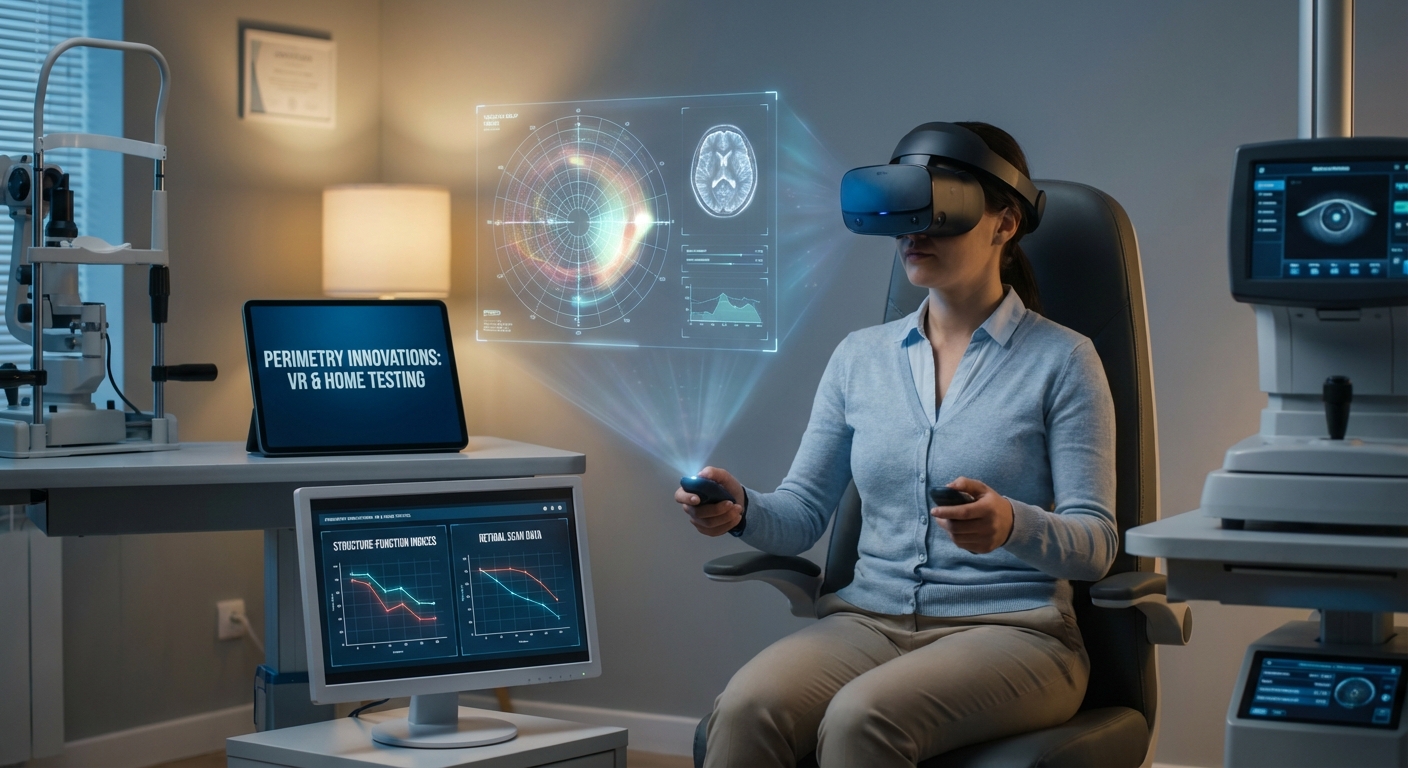
Visual field testing (perimetry) remains indispensable in glaucoma and neuro-ophthalmic care. For decades the Humphrey Field Analyzer (HFA) has been the clinical standard (pmc.ncbi.nlm.nih.gov), but its bulky hardware and lengthy exams limit accessibility – issues highlighted during the COVID-19 pandemic. Virtual reality (VR) headsets and home-based platforms promise more flexible testing. Recent studies show these new methods can rival standard perimetry: one prospective trial found VR-perimeter mean deviation (MD) scores correlate strongly with HFA (Spearman r ≈0.87, p<0.001) (pmc.ncbi.nlm.nih.gov). Similarly, prototype VR goggle tests on smartphones yielded a high correlation with HFA fields (Spearman r=0.808) (pmc.ncbi.nlm.nih.gov). A 2023 systematic review concluded VR devices perform comparably or even better than conventional perimeters in many respects (pmc.ncbi.nlm.nih.gov) – they are more patient-friendly (better fixation, comfort) and far more portable for patients with mobility limitations. These innovations promise similar diagnostic accuracy to HFA while offering easier use, shorter tests, and potential for remote monitoring.
Headset-Based Perimetry: Accuracy and Usability
Head-mounted VR perimeters immerse patients in a controlled environment and often include built‐in eye‐tracking. In clinical studies, VR devices have delivered visual field metrics nearly equivalent to standard perimetry. For example, Griffin et al. found that glaucoma patients’ MD values from a headset (Olleyes VisuALL) and HFA corresponded closely (Spearman r=0.871) (pmc.ncbi.nlm.nih.gov). Differences in point-by-point sensitivities averaged only ~0.4 dB, with particularly strong agreement in mild-to-moderate glaucoma (pmc.ncbi.nlm.nih.gov). In a comparably sized study of a smartphone-VR setup, mean thresholds in four quadrants and global field showed no significant differences, supporting clinical interchangeability (pmc.ncbi.nlm.nih.gov).
Notably, VR headsets markedly improve user comfort and test conditions. Patients can sit or stand without a chinrest, eliminating fatigue from head restraints (www.mdpi.com). For instance, the lightweight Pico-based VisuALL headset dispenses with trial lenses and confines, yet maintains image quality and fixation monitoring (www.mdpi.com) (pmc.ncbi.nlm.nih.gov). One trial reported testing times cut by over 60% (7 vs 18 minutes) using VR instead of HFA, and participants rated the VR exam as much more comfortable due to the headset design removing chin rests and pads (www.mdpi.com) (www.mdpi.com). The immersive display blocks ambient light and can integrate voice prompts and gaze feedback to keep patients engaged. In fact, a 2025 controlled study found that elderly or mobility-impaired patients preferred VR testing at bedside over HFA bowls, and the VR system even included AI analytics for tracking fixation (www.mdpi.com) (www.mdpi.com).
Across published devices, VR perimeters have high patient tolerability: subjects report less claustrophobia and find headset tests less stressful than conventional bowl perimetry (pmc.ncbi.nlm.nih.gov) (www.mdpi.com). By isolating visual stimuli from real-world distractions, VR often yields more reliable fixation. For example, the systematic review found that patients had better gaze fixation with VR devices than with standard perimeters, and even severely impaired eyes could be reliably tested because the fellow eye keeps fixated (pmc.ncbi.nlm.nih.gov) (pmc.ncbi.nlm.nih.gov). Overall, VR headsets appear to deliver equivalent test accuracy to HFA for most patients, while substantially improving usability and test efficiency (pmc.ncbi.nlm.nih.gov) (www.mdpi.com).
Home-Based and Tablet Perimetry
Alongside VR gear, several tablet- and browser-based perimeters enable home visual field testing on personal devices. These platforms vary in design (often using flickering or moving targets) but share low cost and ease of access. The Melbourne Rapid Fields (MRF) suite is a leading example: an FDA-cleared iPad app (for office use) and a web version for unsupervised home testing. In clinic comparisons, MRF’s MD and pattern standard deviation (PSD) values were comparable to HFA: one cross-sectional study in glaucoma eyes showed no significant difference in MD or PSD between MRF and HFA mean profiles (pmc.ncbi.nlm.nih.gov). MRF tended to take slightly less time than HFA (e.g. 5.7 vs 6.3 minutes per eye) (pmc.ncbi.nlm.nih.gov). Overall, the investigators concluded MRF is a cost-effective, user-friendly alternative for settings lacking access to standard perimeters (pmc.ncbi.nlm.nih.gov).
Crucially for home monitoring, recent trials report that such systems are reliable and valid outside the clinic. In a 2025 study of 53 glaucoma patients (mild to advanced), unsupervised MRF online tests at home showed very high agreement with the patients’ recent in-clinic HFA results. Mean Deviation had an intra-class correlation (ICC) of 0.905 between home-MRF and clinic HFA, and pattern deviation also correlated (ICC≈0.685) (pubmed.ncbi.nlm.nih.gov). Even more reassuring, repeated home tests were highly repeatable: MRF’s MD ICC was 0.983 and PSD ICC 0.947 on test–retest (pubmed.ncbi.nlm.nih.gov). Bland–Altman analysis found that 95% limits for MD were roughly ±3 dB on repeat testing, which is similar to standard perimetry variability (pubmed.ncbi.nlm.nih.gov). Such concordance suggests clinicians can trust home-perimeter MD values to track trends. Patients report positive attitudes: in that trial, most users easily accessed the online test and valued remote monitoring (pmc.ncbi.nlm.nih.gov), though adherence waned by 6 months. In another approach, Online Circular Contrast Perimetry (OCCP) – a web-based flicker test – also yielded comparable clinic vs home fields. At baseline, home vs clinic OCCP showed only ~1.3 dB difference in MD on average, with good agreement in PSD and a similar rate of false positives/negatives (pmc.ncbi.nlm.nih.gov). Thus, multiple home perimeters have demonstrated acceptable accuracy, albeit real-world studies note challenges in long-term compliance (pmc.ncbi.nlm.nih.gov) (pubmed.ncbi.nlm.nih.gov).
In practice, home systems require patient selection and support. Ideal candidates are reliable technology users (e.g. literate, mildly affected glaucoma patients) who can be trained on positioning and response. Initial onboarding (often via video call) and practice sessions help overcome the learning effect, since first tests may be slightly less sensitive. Many studies include a short tutorial or supervised practice: e.g. a MRF study provided a one-minute demo before testing (pmc.ncbi.nlm.nih.gov). Frequent testing itself familiarizes patients, and – interestingly – high-frequency home testing has been shown to reduce variability. In long-term home-VR monitoring (Toronto Portable Perimeter), inter-test MD variability shrank by ~30% compared to conventional HFA (RMS error ≈1.18 dB vs 1.67 dB) (pmc.ncbi.nlm.nih.gov). In summary, validated home platforms can mirror clinic perimetry in accuracy. Their success depends on easy-to-use interfaces, remote training, and motivation; adherence may drop over time unless patients and staff stay engaged (pmc.ncbi.nlm.nih.gov) (pmc.ncbi.nlm.nih.gov).
Structure-Function Composite Indices
Traditional visual field indices like Mean Deviation (MD) and Visual Field Index (VFI) summarize functional loss but ignore retinal structure. Conversely, optical coherence tomography (OCT) provides objective measures (e.g. retinal nerve fiber layer thickness) of glaucomatous damage. New composite indices aim to merge the two for better progression detection. The Combined Structure-Function Index (CSFI) is one leading example. It uses published formulas to estimate retinal ganglion cell (RGC) counts from OCT and from perimetry, then averages them into a single “percent RGC loss” metric (pmc.ncbi.nlm.nih.gov). By integrating both tests, CSFI has shown superior performance for staging glaucoma: in one study, CSFI discriminated early vs moderate glaucoma (ROC AUC 0.94) and moderate vs advanced (AUC 0.96), far outperforming OCT thickness alone (≤0.77) (pmc.ncbi.nlm.nih.gov). Notably, two eyes with identical OCT RNFL thickness (56 μm) but very different MDs (–13.3 vs –24.5 dB) were clearly distinguished by CSFI (74% vs 91% RGC loss) (pmc.ncbi.nlm.nih.gov), whereas any single OCT or MD measure would miss the severity gap.
For longitudinal use, composites also offer advantages. Since many RGCs can be lost before a statistically significant MD drop appears on SAP (pmc.ncbi.nlm.nih.gov), combining structure and function provides more “endpoints” for glaucoma progression. Studies suggest CSFI can predict progression sooner than MD alone (pmc.ncbi.nlm.nih.gov). For example, Sao Paulo’s Ogawa et al. found overall CSFI correlated tightly with MD and VFI in mild/advanced eyes (r≈–0.88) but less so in moderate glaucoma (pmc.ncbi.nlm.nih.gov), implying CSFI may detect ongoing damage even when perimetry plateaus mid-stage. In practical terms, this implies a composite metric could flag change even if MD slope is still flat. While large-scale evidence on progression detection is evolving, the early data indicate combined indices add sensitivity: Medeiros et al. reported CSFI’s AUC of ~0.94 for glaucoma detection (vs 0.85 for preperimetric cases) – performance that “compares favorably” to MD or OCT alone (pmc.ncbi.nlm.nih.gov). In sum, structure-function indices (like CSFI or newer machine-learning models) complement MD/VFI by quantifying percent neural loss and may reveal progression earlier, especially in pre-perimetric or mid-stage cases.
However, MD and VFI remain indispensable. Each has limitations: MD can be influenced by cataract and loses sensitivity at the severe end, while VFI (a weighted score of remaining “useful” field) tends to floor out in advanced disease (pmc.ncbi.nlm.nih.gov). Composite indices can mitigate these issues by balancing the strengths of both tests. As one review notes, structural and functional tests have different variability and scales, and combined approaches “increase the number of endpoints” for trials and monitoring (pmc.ncbi.nlm.nih.gov) (pmc.ncbi.nlm.nih.gov). In practice, clinics should view MD/VFI and OCT metrics as complementary, with composites offering a single summary when available.
Test-Retest Variability and Learning Effects
Every perimetric method exhibits inherent variability. Even standard SAP test–retest variability is on the order of ~1–2 dB for MD in glaucoma eyes. (pmc.ncbi.nlm.nih.gov) New devices are no different, but they can often reduce variability by enabling more frequent testing. This was evident in a two-year home-monitoring study: high-frequency VR tests halved the effective MD noise (RMS error ~1.18 dB) compared to clinic HFA tests (pmc.ncbi.nlm.nih.gov). Frequent repetition tightened trend-lines, making progressive change easier to detect.
Learning effects are another universal consideration. Inexperienced patients typically get better scores on their second perimetry session than their first. Most studies address this by providing practice/screening tests. For example, the iPad MRF protocol used a one-minute demo run to ensure understanding (pmc.ncbi.nlm.nih.gov). Clinicians piloting these tools should likewise build in a short training or two, and treat the first test as a “familiarization trial” especially if the patient is new to threshold-perimetry. Performance reliability indices (false positives/negatives, fixation loss) should be monitored: published home-VR series found higher though still acceptable false-positive rates (≈5% vs 3% in clinic) and slightly more patient-initiated pauses, but 83% of VR home tests met standard reliability thresholds (pmc.ncbi.nlm.nih.gov). This mirrors prior tele-perimetry reports, and suggests that with proper guidance most patients can achieve repeatable results.
Patient selection for new perimetry is key. Virtually any cooperative adult or child who can follow simple instructions may undertake VR testing, including those with physical limitations. In fact, VR perimetry has been proposed as especially useful for wheelchair-bound or arthritic patients who struggle with traditional bowls (pmc.ncbi.nlm.nih.gov). The immersive design also benefits pediatric glaucoma care by engaging younger patients. Conversely, patients with severe cognitive impairment or vertigo may find headsets disorienting, so alternative methods should remain available. Similarly, home-testing requires motivated, tech-capable individuals with reliable internet. Ensuring patients have adequate vision (e.g. ~20/40 or better), glasses management, and a quiet test environment is essential.
Implementation and Clinical Evaluation
Integrating these innovations into a practice requires careful piloting. Initial trials can involve side-by-side comparisons: have patients run the new device and the standard perimeter in one visit. Metrics like MD, PSD/VFI, and pointwise sensitivity should be examined for systematic biases. For example, small systematic shifts (e.g. a VR device reading 0.5 dB higher MD on average) should be quantified so clinicians can interpret trends properly. Any normative database or threshold algorithm differences must be understood. It may be prudent to establish internal normative ranges by testing a group of healthy volunteers with the new device.
Practices should also gauge usability. Patient feedback on comfort, ease of instructions, and preference is important. As trials have shown, most find VR perimeters more pleasant (pmc.ncbi.nlm.nih.gov) (www.mdpi.com); documenting this can reassure skeptical staff and patients. Evaluate test durations and error rates: if new exams are markedly shorter or have fewer fixation losses, that is an operational win. Likewise, track reliability indices. A well-validated system should produce fixation losses, false positives, and false negatives at rates similar to clinic perimetry. With home tests, monitor compliance: experience suggests enrollment is high but long-term adherence can drop (only ~70–80% did a first home VF, then fewer remained active beyond a year) (pmc.ncbi.nlm.nih.gov) (pmc.ncbi.nlm.nih.gov). Scheduled reminders, patient education, and incentives (e.g. linking results directly to EHR notes) can improve retention.
Data integration is another hurdle. Many VR or home-perimetry platforms offer cloud-based reporting. Clinics can pilot to ensure these outputs (PDFs or EMR-entry files) fit into their workflow. It may be useful to run a prospective “validation” period where the new perimeter’s progression flags are compared against Goldmann or HFA event/trend analyses. Composite indices (CSFI or similar) will require additional software (either built-in device analytics or external tools) and staff training. Starting with stable or clearly progressing eyes is wise so discrepancies can be spotted early without patient risk.
Finally, documentation is essential. Any new device should be described in the patient’s chart alongside standard fields, and consent forms updated if necessary (especially for at-home tele-testing). Pilots should run long enough to accumulate several tests per eye (often 4–6) to establish a baseline and repeatability_before switching fully. By systematically comparing results, training staff, and educating patients, clinics can responsibly adopt VR and home perimetry. Over time, the improved accessibility and engagement of these tools may lead to more frequent monitoring and earlier detection of glaucoma progression in routine practice.
Conclusion
Emerging perimetry technologies – notably VR headsets and home-monitoring platforms – are proving accurate and user-friendly alternatives to conventional bowl perimetry. They generally match Humphrey-derived global indices while offering shorter tests and better patient comfort (pmc.ncbi.nlm.nih.gov) (www.mdpi.com). Validated home systems (e.g. MRF, OCCP, smartphone VR) correlate well with clinic VFs and show excellent test-retest repeatability (pubmed.ncbi.nlm.nih.gov) (pmc.ncbi.nlm.nih.gov), though real-life compliance can wane. New structure-function composite indices (like CSFI) further enhance progression detection by combining OCT with VF data, often outperforming MD/VFI alone for staging and early change (pmc.ncbi.nlm.nih.gov) (pmc.ncbi.nlm.nih.gov). Clinics should carefully pilot these tools – verifying agreement with standard perimetry, ensuring patients can learn the tests, and building appropriate workflows – to harness their benefits for glaucoma management.
TAGS: ["virtual reality perimetry", "home visual field testing", "glaucoma monitoring", "optical coherence tomography", "structure-function index", "visual field index", "test variability", "tele-perimetry", "patient comfort", "glaucoma progression"].