
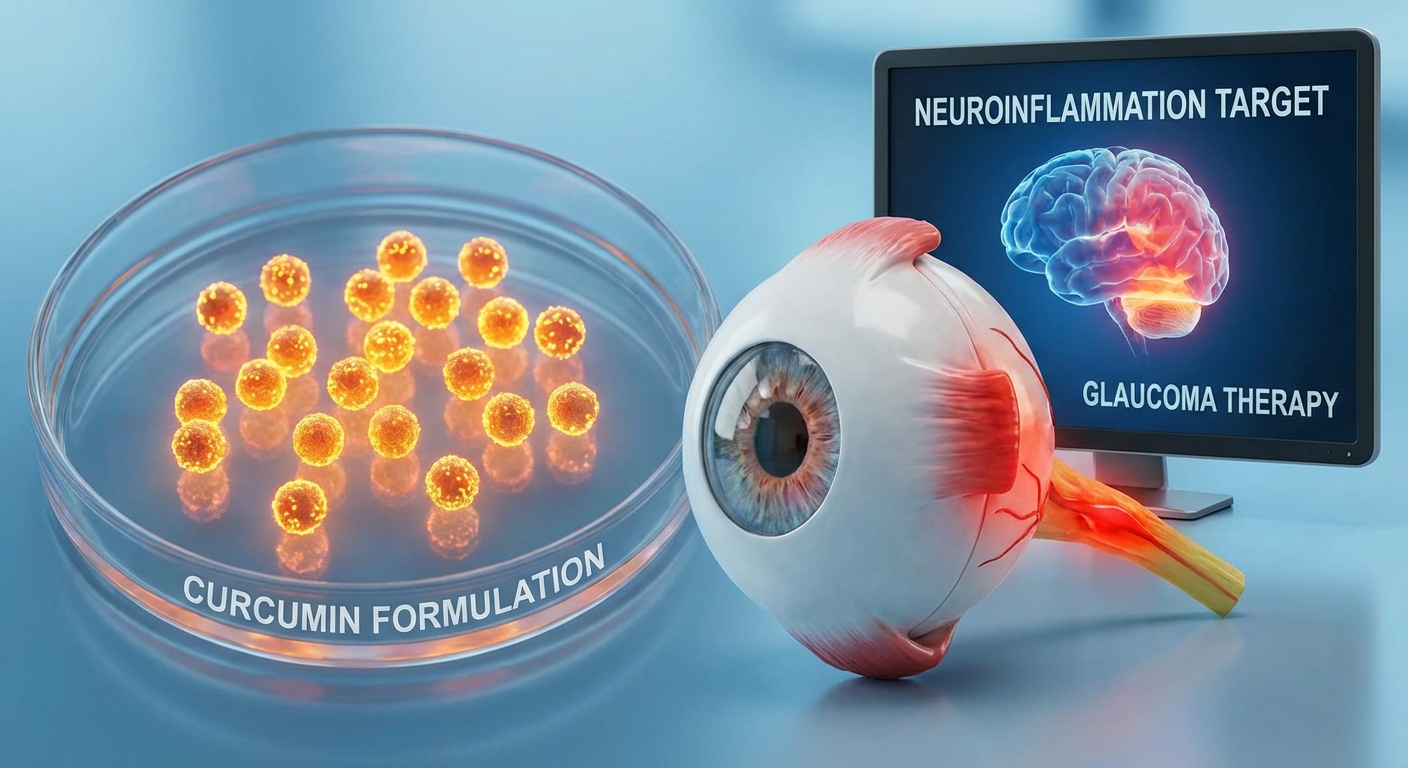
Curcumin for Neuroinflammation in Glaucoma: Mechanisms and Formulations
Glaucoma is a progressive optic neuropathy marked by retinal ganglion cell (RGC) loss and vision field deficits. In addition to elevated intraocular pressure (IOP), oxidative stress and neuroinflammation are important contributors to RGC degeneration (pmc.ncbi.nlm.nih.gov). Curcumin, the bioactive polyphenol from turmeric, exhibits potent anti-inflammatory and antioxidant activity that could protect RGCs. Curcumin modulates many signaling pathways involved in inflammation and cell survival. For example, it inhibits the pro-inflammatory transcription factor NF-κB (nuclear factor kappa B) and the JAK/STAT pathway, while activating PI3K/Akt and Nrf2/HO-1 antioxidant pathways (pmc.ncbi.nlm.nih.gov). These actions reduce inflammatory cytokines and free radicals in ocular tissues, thereby reducing RGC apoptosis (pmc.ncbi.nlm.nih.gov) (pmc.ncbi.nlm.nih.gov). Curcumin also upregulates antioxidant enzymes (e.g. superoxide dismutase, HO-1) via Nrf2, preserving mitochondrial function in neurons (pmc.ncbi.nlm.nih.gov). In short, curcumin’s “master switch” effects on genes like NF-κB and Nrf2 translate into neuroprotection under glaucoma-like stress (pmc.ncbi.nlm.nih.gov) (pmc.ncbi.nlm.nih.gov). Lowering inflammation and oxidative damage can help maintain RGC survival; for instance, in cell models RGC viability improved after curcumin treatment under toxic stress (pmc.ncbi.nlm.nih.gov) (pubmed.ncbi.nlm.nih.gov).
However, curcumin’s clinical use has been limited by extremely poor oral bioavailability (due to low water solubility and rapid metabolism) (pmc.ncbi.nlm.nih.gov) (pmc.ncbi.nlm.nih.gov). This has spurred development of bioavailability-enhanced formulations.
Enhanced Curcumin Formulations and Ocular Delivery
Several novel delivery systems dramatically increase curcumin’s availability and ocular penetration. Phospholipid complexes (e.g. Meriva®, a lecithin/curcumin phytosome) significantly boost systemic absorption. In rats, curcumin delivered as a phosphatidylcholine complex achieved ~5-fold higher blood levels than unformulated curcumin (pubmed.ncbi.nlm.nih.gov). In humans, Meriva tablets (typically 1–2 g/day, ~200–500 mg curcuminoids) are well tolerated and produce much higher blood curcumin than plain turmeric powder (pmc.ncbi.nlm.nih.gov) (pubmed.ncbi.nlm.nih.gov). Phospholipid formulation also concentrates curcumin in membrane-rich tissues, which may benefit nervous tissue delivery.
Nanoparticles and lipid carriers are another strategy. Curcumin-loaded solid nanoparticles and nanostructured lipid carriers (NLCs) improve water dispersibility and protect curcumin during transit. For example, one study created 14–20 nm curcumin nanocarriers using D-α-tocopherol polyethylene glycol (TPGS) and Pluronic F127. These nanocarriers solubilized high curcumin loads and delivered it effectively to retinal tissues (pmc.ncbi.nlm.nih.gov). Twice-daily topical application of this curcumin nanodrop in rodent glaucoma models (ocular hypertension and partial optic nerve transection) significantly reduced RGC loss relative to controls (pmc.ncbi.nlm.nih.gov). Similarly, a hot-melt NLC formulation (~67 nm size) showed ~2.5-fold greater corneal permeation ex vivo than free curcumin (pmc.ncbi.nlm.nih.gov). These nanoparticles can be concentrated into eye drops, increasing curcumin within ocular tissues.
Polymeric micelles also enhance ocular delivery. A curcumin nanomicelle using a PVCL-PVA-PEG (polyvinyl caprolactam–polyvinyl acetate–PEG) graft copolymer improved curcumin’s solubility and stability (pubmed.ncbi.nlm.nih.gov). In vitro tests showed much greater corneal epithelial uptake and penetration than free curcumin, and in vivo anti-inflammatory efficacy in rabbit eyes (pubmed.ncbi.nlm.nih.gov). Importantly, the micellar drops were well tolerated with no ocular irritation (pubmed.ncbi.nlm.nih.gov). Cyclodextrin inclusion complexes have likewise been used: spray-dried curcumin-HPβCD formulations greatly increased curcumin solubility and permeability across corneal and retinal epithelia (pubmed.ncbi.nlm.nih.gov).
In summary, Meriva (phospholipid), nanoparticles/NLCs, and nanomicelles each overcome curcumin’s solubility issues and enable ocular penetration. These delivery systems maintain curcumin in solution or protect it from metabolism, allowing more to reach the retina. For instance, in vitro/ex vivo studies consistently show enhanced transcorneal flux with nanoparticle or micelle formulations (pubmed.ncbi.nlm.nih.gov) (pmc.ncbi.nlm.nih.gov). Topical nanocarrier drops can deliver curcumin directly to the eye, bypassing first-pass metabolism and avoiding high GI doses (pmc.ncbi.nlm.nih.gov) (pubmed.ncbi.nlm.nih.gov).
Preclinical Glaucoma Studies
Numerous preclinical models support curcumin’s neuroprotective effects on RGCs. In vitro, retinal cell cultures show that curcumin pre-treatment improves survival under stress. For example, transformed RGC-5 cells exposed to the toxin staurosporine had elevated protease levels and cell death; curcumin co-treatment markedly preserved RGC-5 viability (pmc.ncbi.nlm.nih.gov) (pmc.ncbi.nlm.nih.gov). In vivo, intravitreal staurosporine caused loss of RGCs and amacrine cells, but curcumin attenuated this RGC loss by restoring NF-κB expression (pmc.ncbi.nlm.nih.gov).
In a mouse ex vivo optic nerve cut model, enucleated eyes (optic nerve transected) developed rapid RGC layer thinning over 24 h. Curcumin treatment prevented this degeneration: it normalized apoptotic markers (caspases and MAPK pathway proteins) and preserved RGC number and retinal thickness (pmc.ncbi.nlm.nih.gov). This suggests curcumin blocks key cell-death cascades in RGCs under injury.
Rodent glaucoma models also yield positive results. In rats with chronically elevated IOP (induced by episcleral vein cauterization), oral curcumin (10 mg/kg/day for 6 weeks) significantly improved RGC survival. Treated eyes showed higher RGC counts and reduced markers of apoptosis (lower caspase-3, Bax and cytochrome c; higher Bcl-2) compared to untreated glaucoma controls (pubmed.ncbi.nlm.nih.gov). Likewise, topical curcumin nanoparticles applied to mice with induced ocular hypertension (OHT) and partial optic nerve transection dramatically reduced RGC loss over 3 weeks versus controls (pmc.ncbi.nlm.nih.gov). These studies used endpoints like Brn3a+ RGC counts, retinal histology, and immunoblots of apoptotic proteins to confirm neuroprotection.
Many studies also note reduced glial activation (microglia) and inflammatory markers with curcumin. Chronic neuroinflammation models emphasize this. For instance, GFAP-IL6 transgenic mice (with retinal inflammation) showed microglial proliferation and retinal thinning, but a 4-week diet of bioavailable curcumin-phytosome drastically lowered microglia numbers and prevented neuronal loss (pmc.ncbi.nlm.nih.gov). This illustrates curcumin’s ability to suppress TLR/STAT signaling in pro-inflammatory glia. Similarly, in vitro curcumin reduced reactive oxygen species and apoptosis in cultured microglia under oxidative stress (pubmed.ncbi.nlm.nih.gov).
Endpoints and limitations: Across models, researchers measure RGC density (e.g. Brn3a labeling), retinal layer thickness, and functional assays like electroretinogram signals. Biochemical endpoints include caspase activation, Bax/Bcl-2 ratio, and inflammatory cytokines. However, animal and ex vivo models differ from human glaucoma in chronicity and complexity. Results may not directly predict clinical effects. Doses used in rodents (e.g. 10–100 mg/kg) often exceed what is practical in humans. Also, topical rodent models may not translate to human ocular delivery. These factors and small sample sizes limit extrapolation.
Early Clinical Signals in Ocular Disease
Although no large glaucoma trials exist yet, small human studies in other eye diseases hint at curcumin’s potential. In chronic central serous chorioretinopathy (CSCR), an open-label study gave patients 1.2 g/day Meriva (providing 240 mg curcuminoids) for one year. After 12 months, 61% of eyes showed improved visual acuity, and 95% had reduced neurosensory detachment thickness on OCT (pmc.ncbi.nlm.nih.gov). Investigators observed fewer relapses and reduced inflammation (choroidal leakage). The study concluded that a bioavailable curcumin formulation stabilized or improved CSCR, suggesting efficacy against retinal inflammation (pmc.ncbi.nlm.nih.gov).
Likewise, in a small pilot trial of diabetic macular edema, 11 patients (12 eyes) with chronic edema took Meriva (Norflo® tablets, 2×600 mg/day) for 3 months. No eyes worsened; 84% improved visual acuity and 92% had reduced retinal thickness by OCT (mean edema decreased significantly) (www.europeanreview.org). These preliminary trials (both open-label) hint that curcumin formulations can favorably modulate retinal disease endpoints (visual acuity and edema) possibly via anti-inflammatory effects. However, they lack control groups and are not glaucoma-specific. No completed human glaucoma trials have reported yet; their endpoints (visual field, OCT RNFL) remain to be tested.
Dosing, Tolerability, and Interactions
Curcumin is generally well-tolerated but absorption is dose-dependent and often limited. In clinical studies, gram-level oral doses (e.g. 2–12 g/day) typically yield very low blood levels (~0.5–1 µg/mL peak) and often some GI side effects (pmc.ncbi.nlm.nih.gov). In the Davis et al. glaucoma study, the human-equivalent dose (800 mg/day) for 6 weeks was associated with mild adverse effects (nausea, diarrhea) and transient lab changes (alkaline phosphatase, LDH) (pmc.ncbi.nlm.nih.gov). In practice, curcumin in enhanced forms (Meriva, Theracurmin) is often used at lower doses (e.g. 200–500 mg curcuminoids daily) to improve compliance and reduce GI upset.
Patients on anticoagulants warrant caution. Curcumin has mild anti-platelet and anticoagulant properties, so co-administration with warfarin or antiplatelet drugs could theoretically increase bleeding risk. Animal studies show high-dose curcumin can raise blood levels of warfarin/clopidogrel but without altering coagulation times or platelet function (pubmed.ncbi.nlm.nih.gov). Nonetheless, because case-reports link turmeric use to altered INR, it is prudent to monitor INR when combining curcumin with anticoagulants. Curcumin may also interact with CYP enzymes and P-glycoprotein modestly, potentially affecting drug metabolism. Finally, high doses (g/day) may interact with herbs or foods (e.g. turmeric has been noted in some interaction checkers), so standard precaution applies.
Designing Rigorous Glaucoma Trials
A future glaucoma trial of curcumin should be randomized, double-blind, placebo-controlled and adequately powered. Likely design: adult patients with early to moderate primary open-angle glaucoma on stable IOP therapy. Exclude those on anticoagulants or with instability. The intervention could be an oral bioavailable curcumin (e.g. Meriva or novel nanoparticle) at a dose bioequivalent to ~500 mg curcuminoids/day, vs placebo, for 1–2 years. Primary endpoints might be structural RGC or RNFL loss (measured by OCT imaging) and/or functional decline (visual field indices like mean deviation) – metrics sensitive to neurodegeneration beyond IOP. Secondary endpoints could include objective measures such as pattern electroretinogram (PERG) or mfERG, and biomarkers in blood or aqueous (e.g. cytokine levels, oxidative stress markers). Compliance would be tracked by pill counts or serum curcumin.
Trial design must account for slow disease progression: enriched enrollment of patients at higher risk (normal-tension or progressing despite low IOP) might increase signal. Adequate duration (≥1–2 years) is essential to detect meaningful change. To confirm specificity, a multi-arm trial with different curcumin formulations could be considered. Safety monitoring would focus on GI symptoms and laboratory tests. Importantly, use of a properly matched placebo (e.g. lecithin without curcumin) is crucial to blind patients to curcumin’s distinctive color. Finally, sufficient sample size and pre-specified subgroup analyses (e.g. by genetic risk or inflammatory phenotype) would help ensure any effect is real.
In conclusion, compelling preclinical evidence shows curcumin’s anti-inflammatory and antioxidant actions support RGC survival in glaucoma models (pmc.ncbi.nlm.nih.gov) (pmc.ncbi.nlm.nih.gov). Innovative delivery systems (phytosomes, nanoparticles, micelles) overcome bioavailability barriers and deliver curcumin to the retina (pmc.ncbi.nlm.nih.gov) (pubmed.ncbi.nlm.nih.gov). Small clinical studies in retinal disease provide encouraging signals (pmc.ncbi.nlm.nih.gov) (www.europeanreview.org). Ultimately, a well-designed clinical trial is needed to establish whether curcumin can safely preserve vision in glaucoma. Until then, curcumin remains a promising adjunct with plausible mechanisms, but not a substitute for proven IOP-lowering therapy.
References: Key findings are supported by preclinical and clinical studies of curcumin in ocular models (pmc.ncbi.nlm.nih.gov) (pmc.ncbi.nlm.nih.gov) (pmc.ncbi.nlm.nih.gov) (pmc.ncbi.nlm.nih.gov) (pubmed.ncbi.nlm.nih.gov) (pubmed.ncbi.nlm.nih.gov).
TAGS: ["curcumin", "glaucoma", "retinal ganglion cells", "neuroinflammation", "antioxidant", "bioavailability", "nanoparticles", "phospholipid complexes", "ocular drug delivery", "clinical trial design"]